
Revisiting A Gate
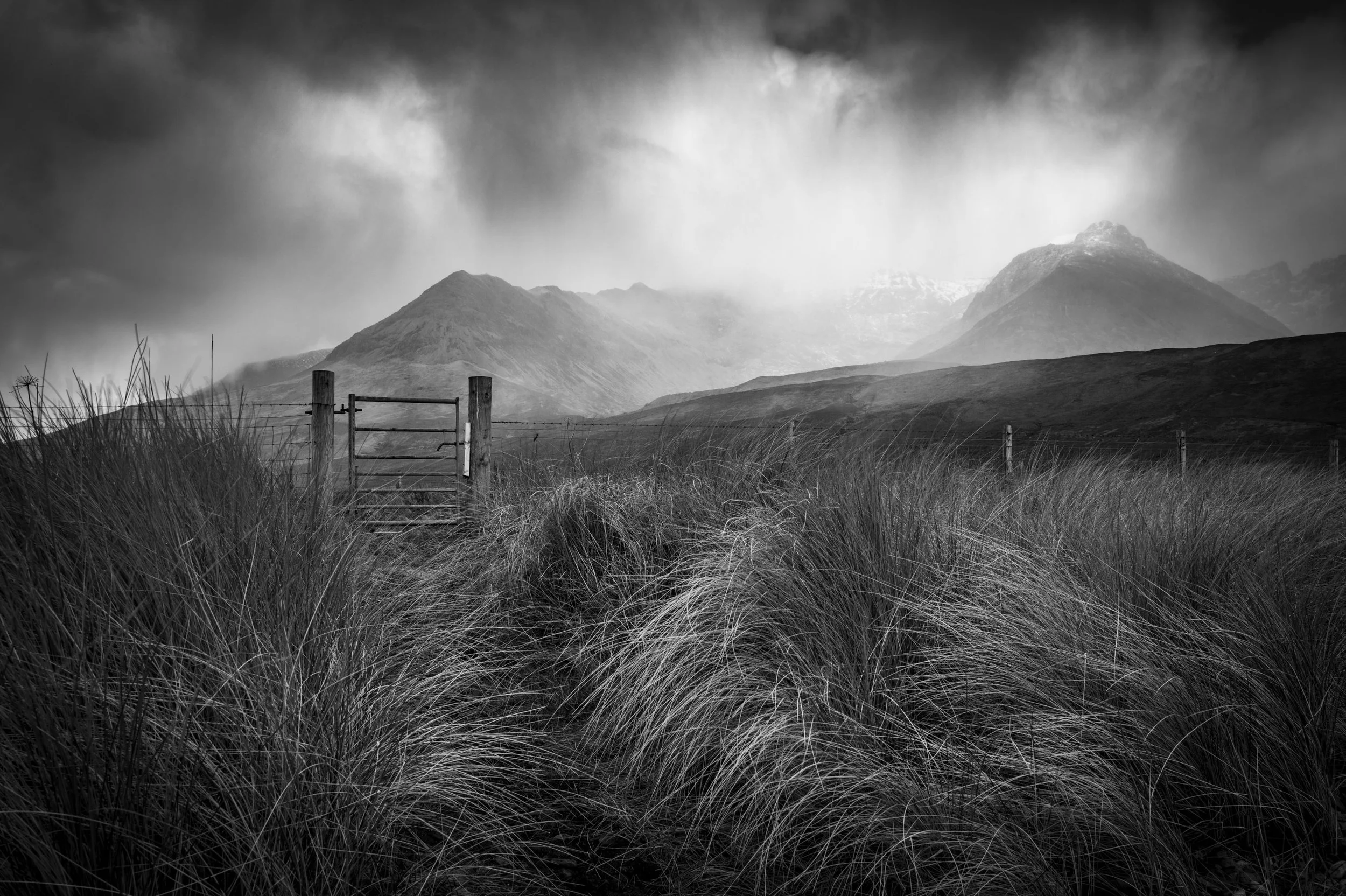
The new version. Leica Q3 1/60th f/10 ISO 100
In this post I revisit a favourite location in Glen Brittle to get some drama that was missing from a favourite composition from 2024, and describe how small changes in position or settings can make big differences to the end result.
A couple of years ago I happened upon a nice composition down near the beach in Glen Brittle. This is one of my favourite parts of Skye, especially in the off season when the campsite is closed and it is possible to have the place to yourself. As well as a beautiful beach with stripy black and white sand patterns at low tide, there is a line of grasses (marram grass?) along the back of the beach.
While it is always tempting to point the camera outwards towards the sea, in this case I think the best photographic opportunities lie in the opposite direction, with the Cuillin mountains acting as a backdrop with the grasses in the foreground.
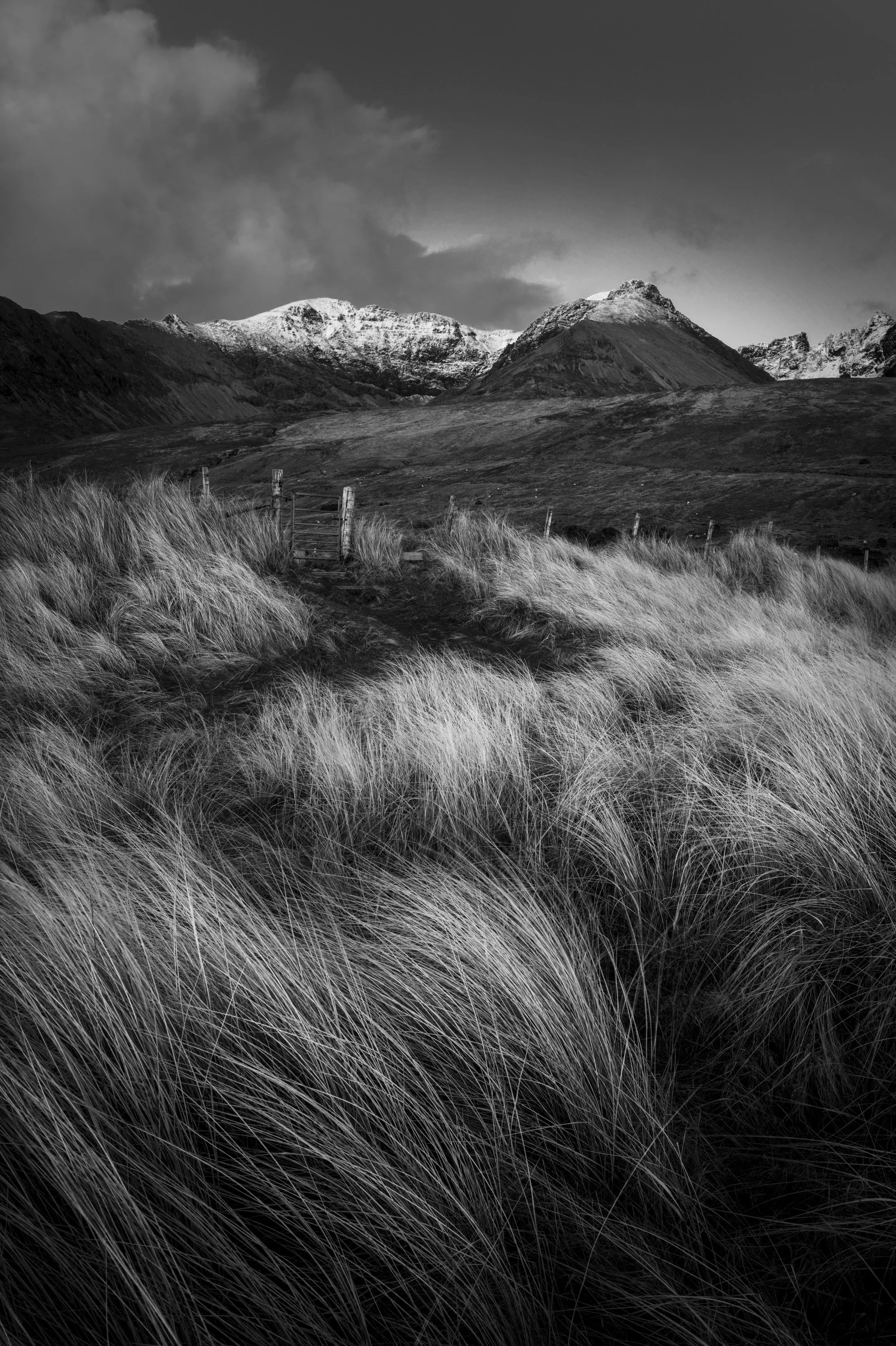
The original shot from 2024. Leica Q3, 0.5 sec, f/16 ISO 50
During my visit back in the winter of 2024, the mountains were nicely snowcapped, which I think adds a really ominous aspect to them as well as enhancing their scale. They must be really big to have snow on top.
I spent a very pleasant while examining different compositional opportunities combining the grasses and mountains, but they lacked an “anchor” to bridge the foreground and background. And there’s an annoying fence all the way along as well.
Interspersed here and there along the fence are some little gates. These let people from the campsite just beyond the fence get easy access down to the beach. I figured I could use one of these gates as my anchor, thereby giving some context to the picture and providing a human element (“if I open that gate, where could it lead…”).
Much micro-positioning then ensued as I tried to find a decent way of bringing together the three components of grasses, gate and mountains. Eventually I found something of a wiggly line leading through the grasses, up to the gate, then to a valley up to the mountains on the horizon. Whoop.
However, the sky wasn’t really playing ball. It lacked drama and was a bit dull. But the other elements were good so I called it “done”.
I had intended this shot to go in the “Fences” section in my new book, Glas, but it didn’t make the cut. The sky wasn’t right, the mountains didn’t look sufficiently large and imposing, and it simply wasn’t good enough. It nagged and nagged at me. There is a lot of potential in the elements that make up the shot, but it lacked the final dimension of drama I wanted.
Cue yesterday, and another winter trip down to the beautiful beach, ignoring the Fairy Pools on the way even though they were very quiet. The skies were clear and the sun was out, although the bitterly cold northerly wind was making its presence felt as soon as I left the cosiness of the car. With no drama in the sky I thought it might be a wasted trip, but I decided to see if I could find some new shapes in the grass that might work for next time.
Well, what do you know…within ten minutes a ferocious-looking storm blew into the Glen from the north. This is Skye after all, and anything can happen. I could see it coming long before the first sharp spike of hail started blasting my face. By this point I had already identified another composition at a gate a little bit further along the beach from the previous shot from two years ago.
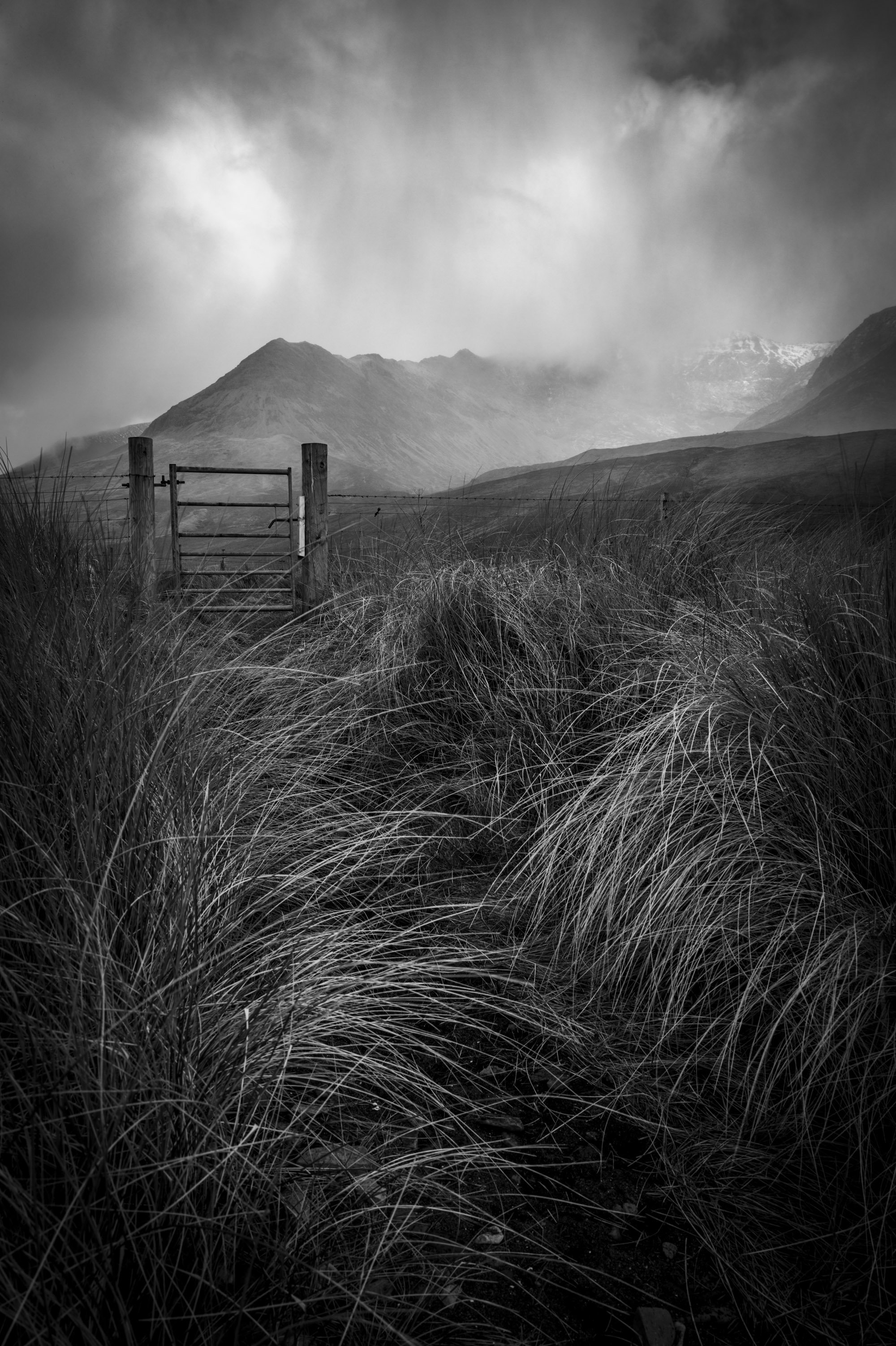
The new version - portrait orientation. Leica Q3 1/80th f/10 ISO 100
I had already decided to position the gate closer in the frame to make it larger. Using a fairly wide angle of 28mm, this also makes the mountains look bigger in relation to the gate.
Small-ish changes like this, minor adjustments in position, can make a lot of difference to the final result. As another example, I didn’t want the left-hand gatepost to break the ridge line of the mountains behind. That would break the continuity of that line and be a bit jarring.
I also wanted enough of a lead-in line in the shape of the grasses to take the eye up the image, to the gate, and then beyond. More small adjustments needed to keep all these elements in the “right” places in relation to each other.
I had decided to abandon my tripod and just hand-hold the camera due to the need for speed in the rapidly changing weather conditions. The little Leica Q3 has very good image stabilisation and I was happy at 1/60th of a second. I decided a bit of movement in the grasses would be nice to emphasise the wind blowing at my face.
Being picky, the gate is a little “tight” on the left hand side but had I turned the camera more to the left I’d have lost some of the mountains, and had I physically moved myself to the left I’d have lost the dark path that leads into the shot. I do love working through tradeoffs like this as I puzzle through the interaction of all the elements.
A big lesson I learned some time ago was to always vary the composition, orientation and settings of a particular scene. You’re there, so make the most of it. It only takes a second to change the aperture from f/10 to f/1.7, so do it. Ditto for switching the camera from landscape to portrait orientation. Often I’ll find I like one of the alternative versions better when I get back home, so it is good to have a choice. Some may say “get it right on location” but I say “nonsense” to that. You may never be back at a particular spot, so make the most of it while you are there.
So below is an f/1.7 shot of the same composition as the first one in this post. Sometimes blurring out the foreground can draw you into the picture more effectively than when everything is totally sharp This is usually because it is more like how our eyes see. We don’t have everything in focus when we look at a scene with our eyes, our brain just fills it all in for us. The camera’s ability to make everything sharp front-to-back is therefore somewhat artificial. In this case though, I think the sharper shot works better. The sticky-up grasses on the left in the two landscape-orientation images are a bit niggly but I decided to put up with them for the sake of preserving the relative position of all the other elements.
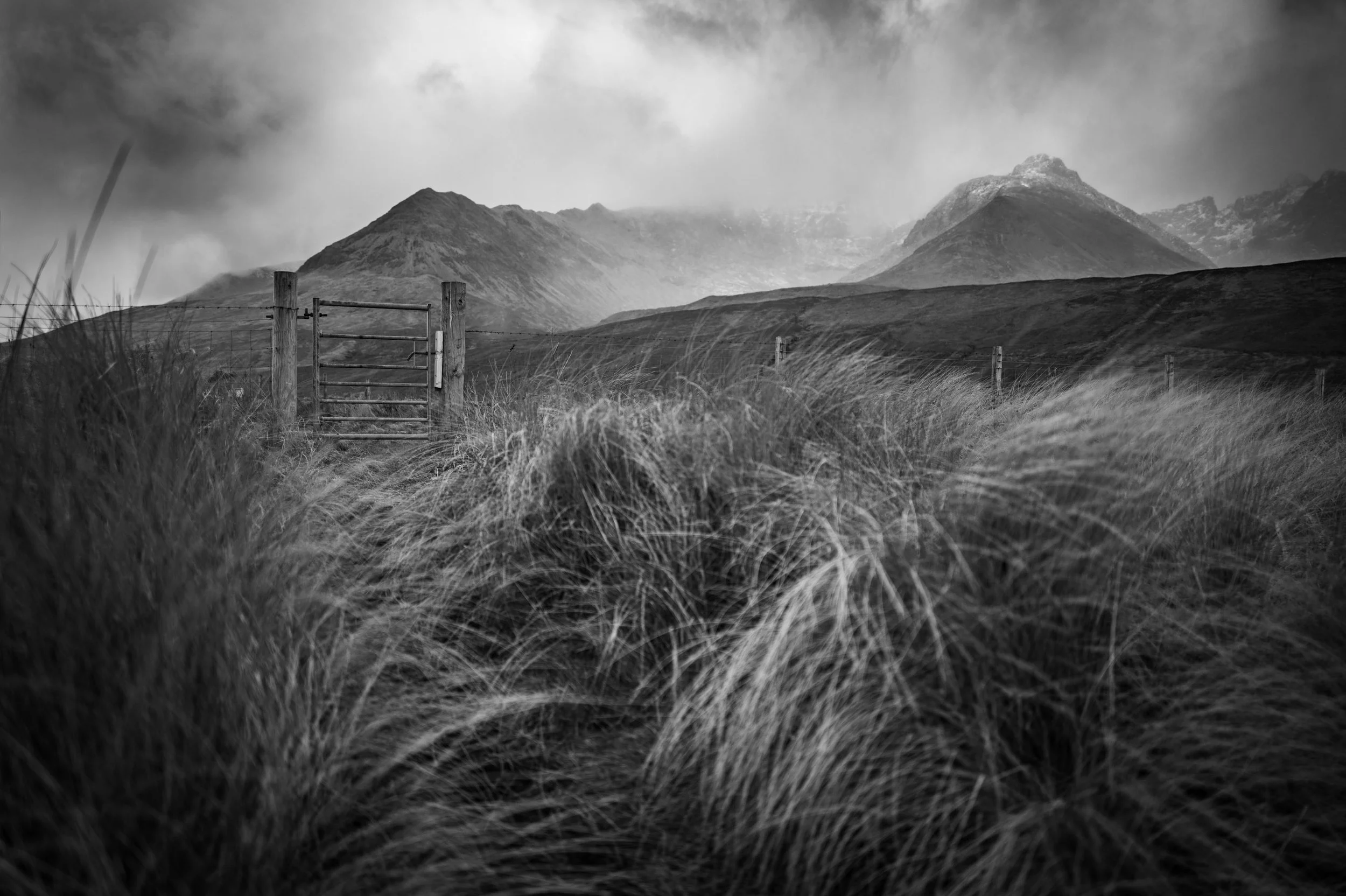
This time at f/1.7. Leica Q3 1/4000th f/1.7 ISO 100
The snow shower blasted down the glen at speed. The small bits of my face that were exposed to the elements felt red and raw from the hail and fine snow that had scoured them. The sky over the mountains changed second-by-second, giving me the much-needed drama that my original photograph from two years ago had been lacking. The different position, keeping the gate closer to the camera, works a lot better as well. It was, as usual, all well worthwhile.
Job done, which was good as the storm blew over to reveal bright sunshine and blue skies again. That five minute window of mad drama was exactly what I needed. Shame that I’ve already published Glas!