
Cracking
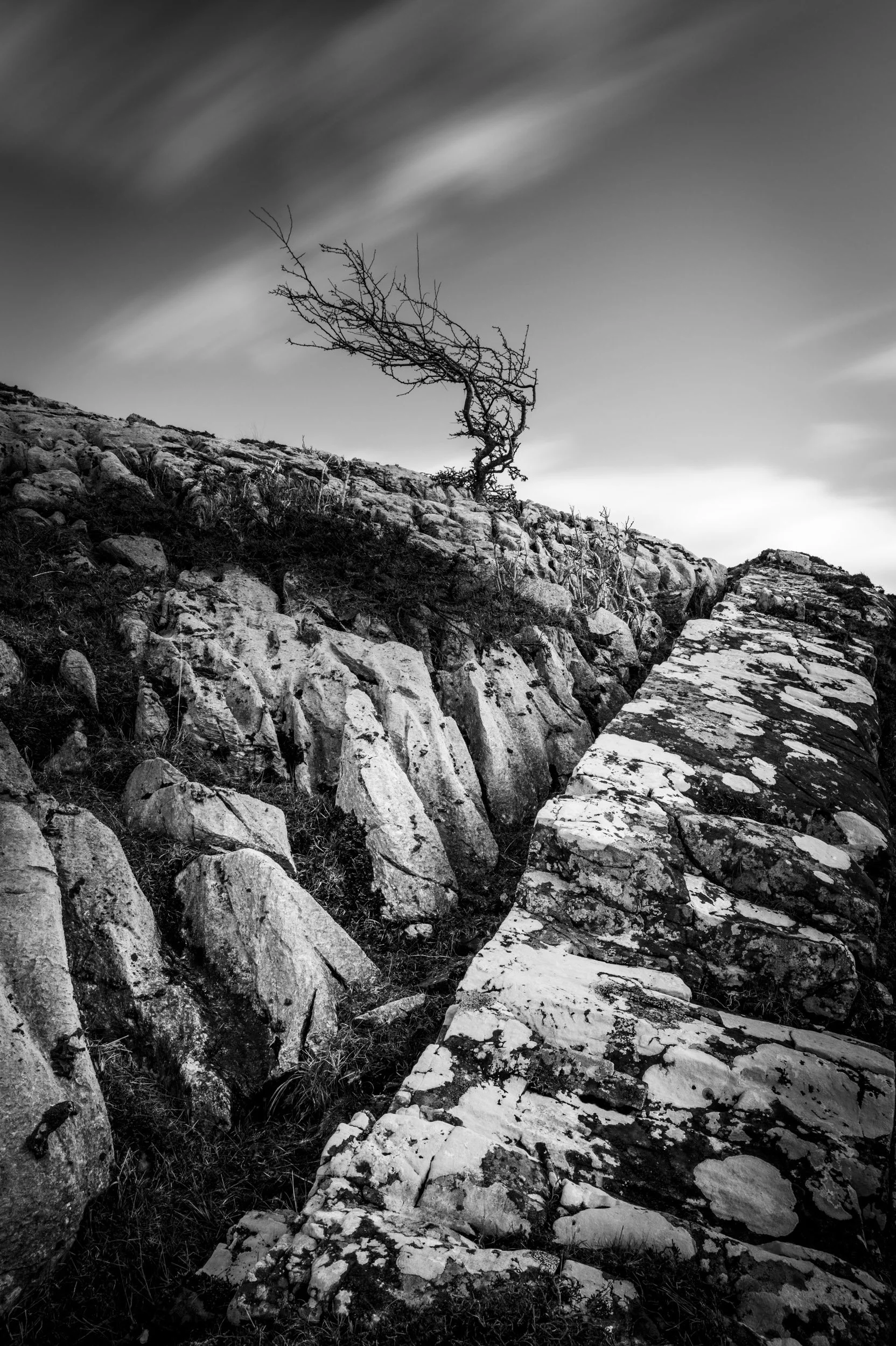
A weather beaten lone tree. Leica Q3 150 sec f/16 ISO 100
Photography is often an excuse for just being outside, exploring and finding new places. Sometimes a nice photograph is a bonus to the main event of gently wandering around the countryside.
I find the geology of Skye to be extremely interesting. People travel from far away to study the rock formations that vary hugely across the island. There’s a really good study here if you would like to know more. I spent a bit of time at university studying geology, with many of the lectures being as impenetrable as the rocks that were their subject matter. It was the field trips that I enjoyed most. Looking closely at how the land has been formed and how the shapes we see now reflect the massive forces that folded and fractured the earth’s crust.
While I don’t remember much about what I learned back then, I do go out of my way to try and find out more about the stuff I’m standing on. This in turn enables me to be more efficient in my search for interesting photography spots. In particular, the elusive lone-tree-on-a-rocky-pavement composition that I enjoy finding and photographing so much.
Here, then, we have an interesting feature, and I hope I’ve got this right. On the left side is fissured, fractured and eroded dolostone pavement. Dolostone is a limestone that has been altered by magnesium-rich groundwater, making it a bit harder than limestone and a darker grey colour. There is a band of the stuff in Skye through the Strath & Torrin area and it makes for an excellent place to explore with a camera.
Dolostone erodes into very sharp, fissured pavement. When I say sharp, it easily slices clothing and flesh should you fall on a particularly pointy bit, as I know from experience. It can be very precarious to walk on and a lot of care is needed. Because of this, deer tend not to venture onto the stuff, which gives the occasional tree just a bit of a chance to grow without being eaten. This is why you can find lone tree compositions like this tucked away in rather inaccessible spots.
The massive linear gap won’t have gone unnoticed in the shot above. This looks to my amateur geologist eye like an intrusive granite dyke. At some point, a weakness in the dolostone will have been exploited by molten granite that pushed through into the crack and solidified, leaving this remarkably straight feature. Nature tends to avoid straight lines so I find they always stand out in the landscape and look almost man-made.
One of the attractions of the lone tree type of shot is that it demonstrates solitude, resilience, strength and loneliness. Anthropomorphising somewhat, the lone tree reflects many of the challenges and feelings of human existence, which is why they resonate with many people.
For this image I made a few conscious choices when setting up the composition. Obviously the tree is the subject, but I wanted to show the side profile of the tree to highlight how it has been shaped by strong winds and weather as it has struggled to its meagre 2m height. To get that side profile I had to ignore some of the backdrop of huge mountains just behind me, and I wanted to position the tree above the horizon to emphasise its shape.
The dyke was the next shape to focus on. I chose to position the camera to get the dyke running diagonally up the image and give a very strong shape to the composition that is hard to ignore. It meets the horizon, which then jerks the eye sharply left to the base of the tree. Nice and simple.
The final thing to work on was the camera settings. With patchy clouds blowing through, I decided to go for a very long shutter speed to show that movement, and reinforce the reason that the tree is shaped the way that it is. A short shutter speed with static clouds would look nice, but it would lack the drama and emotional connection that you get with the impression of wind blowing through at speed. I ended up with a 150 second exposure thanks to a polariser (to darken the blue sky a bit) and an ND1000 filter. f/16 got everything in focus front-to-back on my Leica Q3, and I kept the ISO low at 100.
I have a lot more still to explore in this area of the island. Photography is such an excellent motivator to get out and about.